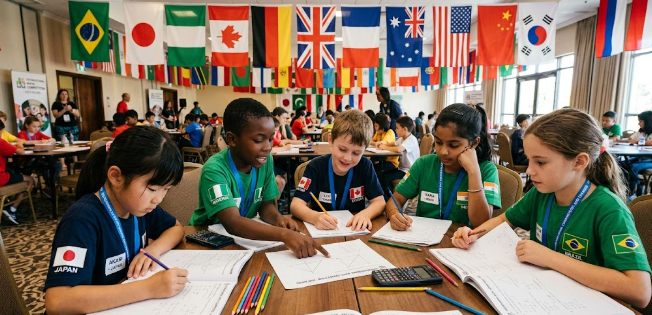
The International Math Olympiad (IMO) is the world's most prestigious mathematics competition for school students. Since its first edition in 1959, the competition has grown into a global event that attracts some of the brightest young mathematicians from more than 100 countries.
For students who enjoy solving challenging problems and exploring mathematics beyond the classroom, the IMO represents the highest level of olympiad achievement.
What Is the International Math Olympiad?
The IMO is an annual competition where each participating country sends a team of up to six students. The examination is held over 2 days. Students solve 3 problems each day and are given 4.5 hours per session. The questions cover areas such as Algebra, Geometry, Number Theory, and Combinatorics.
Unlike many school examinations, the IMO does not include multiple-choice questions. Students must write complete mathematical proofs and justify every step of their reasoning. The focus is not on memorization or speed but on creativity, logical thinking, and deep mathematical understanding.
How Do Students Reach the IMO?
Qualifying for the International Math Olympiad is extremely competitive. In India, students typically progress through a series of national-level olympiad examinations and training programs before being considered for the final team selection. Only a small number of students ultimately earn the opportunity to represent the country at the IMO.
Many students begin developing olympiad skills at a much earlier stage through competitions such as the EduJunior Olympiads, where they are introduced to logical reasoning, problem-solving techniques, and mathematical thinking beyond the school curriculum. These early experiences often help build the foundation needed for more advanced olympiad challenges later on.
Why Is the IMO Important?
The International Math Olympiad is about much more than medals and rankings. It encourages students to think independently, analyze complex problems, and develop rigorous reasoning skills. Participants learn how to approach unfamiliar challenges with patience and creativity, qualities that are valuable in many academic and professional fields.
The skills developed through olympiad mathematics can benefit students interested in engineering, computer science, research, economics, data science, and many other disciplines. Many former IMO participants have gone on to make significant contributions in science, technology, and academia.
How Do Students Prepare?
Preparation for the IMO usually takes several years rather than a few months.
Successful students focus on understanding mathematical concepts deeply rather than memorizing formulas. They regularly solve challenging problems, study previous olympiad papers, and learn a variety of problem-solving strategies.
A typical preparation plan includes:
Building strong fundamentals in mathematics
Practicing olympiad-style questions regularly
Learning proof-writing techniques
Analyzing previous years' problems
Participating in mathematics competitions and training camps
For younger students, competitions such as the EduJunior Math Olympiad can provide valuable exposure to the style of thinking required in olympiad mathematics and help develop confidence at an early stage.
Is the IMO Only for Mathematical Geniuses?
One of the most common misconceptions about the IMO is that only naturally gifted students can succeed. While mathematical talent can certainly help, most successful participants achieve their results through years of consistent effort, curiosity, and practice. Strong problem-solving skills are developed over time through regular exposure to challenging questions and a willingness to learn from mistakes.
Students who start early and participate in competitions, including foundation-level olympiads such as the EduJunior Math Olympiad, often develop the habits and thinking skills that support future success.
Also Check Out: EduJunior Reasoning Olympiad
Why Participate in The International Math Olympiad
The International Math Olympiad represents the highest level of school mathematics competition, but its value extends far beyond the contest itself. The journey toward olympiad mathematics teaches students how to think critically, solve problems creatively, and approach challenges with persistence.
Whether a student eventually competes at the IMO or simply enjoys participating in olympiads, the skills gained along the way can have a lasting impact.
Competitions such as the EduJunior Math Olympiad can serve as an excellent starting point, helping students build confidence & develop a deeper appreciation for mathematics from an early age.